Our History
The Hindu College in Machilipatnam, Andhra Pradesh, has a rich history dating back to 1856 when it was founded by Honourable Sri A. Seshayya Sastriar, a resident of Machilipatnam and Collector’s Huzur Sheristadar. Initially, it was known as the Hindu Anglo Vernacular School and was later renamed Hindu High School in 1863. Sri Mungamuri Narasimham Pantulu, a Treasury Deputy Collector, played a significant role in the institution’s growth and development, serving as the President of the Managing Committee.
Over the years, the college has evolved and expanded, becoming an Intermediate College in 1928 and a First Grade College in 1934. Today, The Hindu College is affiliated with Krishna University and offers various undergraduate and postgraduate courses, including MBA, MCA, and (link unavailable).
The college has a strong legacy of producing talented individuals and has been recognized for its academic excellence. Its vision is to provide quality education and promote overall development, while its mission is to empower students to succeed in life and contribute to society.
The Hindu College in Machilipatnam, Andhra Pradesh, has a rich history dating back to 1856 when it was founded by Honourable Sri A. Seshayya Sastriar, a resident of Machilipatnam and Collector’s Huzur Sheristadar. Initially, it was known as the Hindu Anglo Vernacular School and was later renamed Hindu High School in 1863. Sri Mungamuri Narasimham Pantulu, a Treasury Deputy Collector, played a significant role in the institution’s growth and development, serving as the President of the Managing Committee.
Over the years, the college has evolved and expanded, becoming an Intermediate College in 1928 and a First Grade College in 1934. Today, The Hindu College is affiliated with Krishna University and offers various undergraduate and postgraduate courses, including MBA, MCA, and (link unavailable).
The college has a strong legacy of producing talented individuals and has been recognized for its academic excellence. Its vision is to provide quality education and promote overall development, while its mission is to empower students to succeed in life and contribute to society.
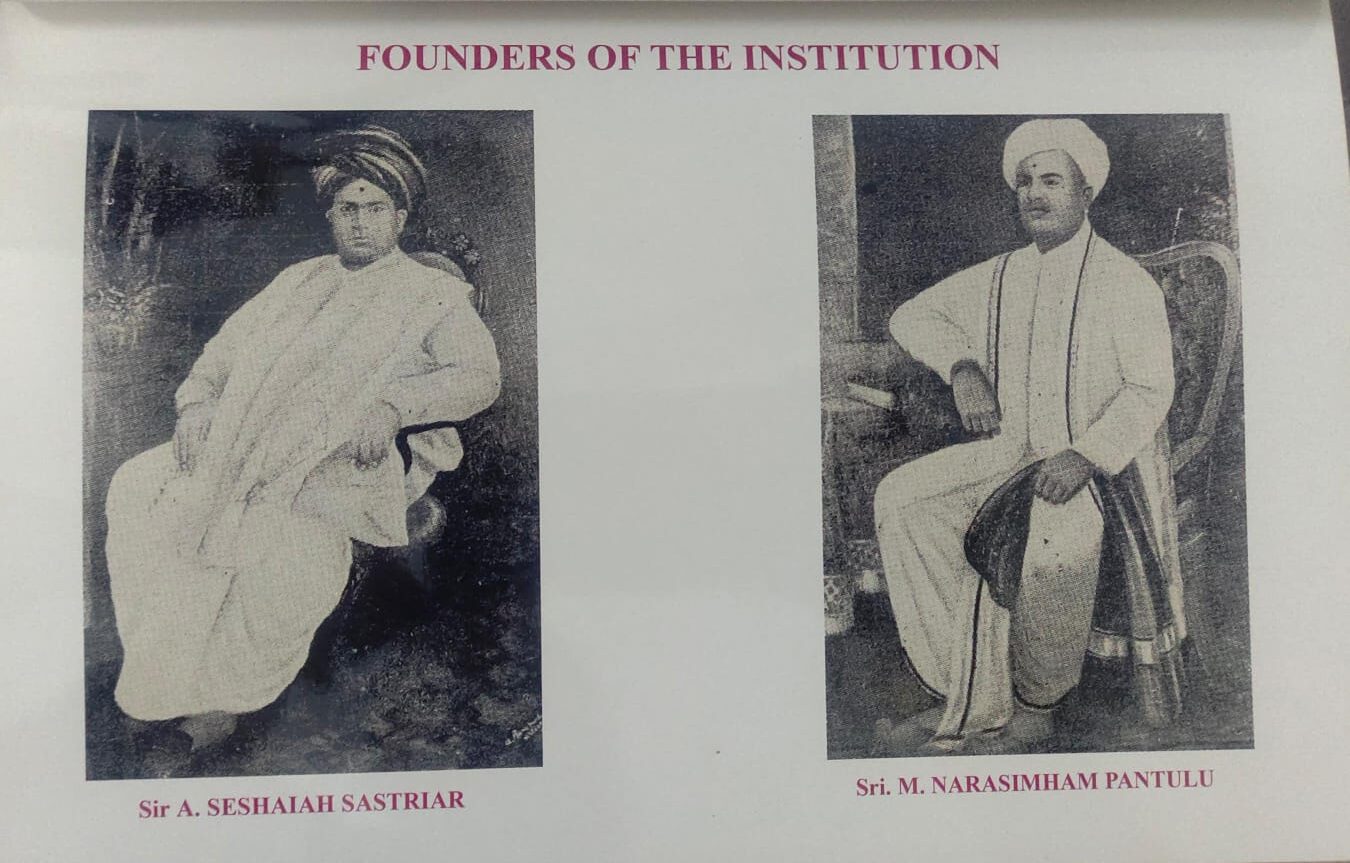
Sri Seshiah Sastriar was born poor and till he made his career, lived in poverty. Born on March, 22, 1828 in Amaravathi, a village near Kumbakonam, the fifth of six sons of a priest who was often hard put to make both ends meet, he was sent to Madras for his School Education. He joined a Missionary school, but there was a riot in that school when a few students were con- verted into Christianity and Seshiah went to a preparatory School started just then by the High School, which Lord Elphinstone, the Governor, opened on April 14, 1841. Seshiah was of the three or four students who made a mark in life. He took the Degree of Proficient in the First scale of Hon- ours standing first among his fellows in the order of merit and received the ring, set with Emeralds of a proficient of the First Class on May 29, 1848.
Sri Seshiah Sastriar was first employ- ed as a Clerk temporary and in a few months made permanent in the Revenue Board in Madras on, a salary of Rs. 25/- P.M. He had a glorious career. By dint of sheer hardwork, he rose to higher positions.
It was the good fortune of this place, Machilipatnam, that Sri Seshiah Sastriar worked as Huzur Sheristhadar to the Collector here. He left this District in 1862 on promotion as Deputy Collector and later rose to very high positions of Inams Commissioner, Dewan of Travan- core, Dewan of Pudukottah, then major princely states of India. He attained the pinnacle of glory in 1902 when he was Knighted by the British Government and awarded K.C.S.I. and soon after, he passed away.
Sri Mungamuri Narasimham Pantulu was born in the year 1805 and had a brilliant academic career and was one of the persons appointed Deputy Coll- ector in 1862-63. This was, as it were,engaged in public activity. Sir Charles Trevelyan, the then Governor of Madras, is said to have observed as follows about the school.
“Seshaiah Sastriar and other founders and supporters of the grant-in-aid Anglo Vernacular school will be known hereafter as those who have planted the germs of an improved learning in this interesting and important part of the Madras Presi- dency. Machilipatnam bids fair to become to the Northern Circars more than Oxford and Cambridge have been to the United Kingdom.”
What better tribute can we pay to the Noble souls who founded this great Institution except to pay our humble homage on this auspicious occa- sion of this Golden jubilee.?
As observed earlier, the school had to pass through many crisis in the formative years partly due to paucity of funds and mostly due to lack of accommodation. Sri Mungamuri Nar- shimam Pantulu made up his mind to provide a permanent locus to the school and in 1863, as luck would have it, a huge piece of land to the South east of the Town (the present premises of the Hindu College) measuring 33 acres was acquired from M/s Lushington and Knox for a price of Rs.9,150/- at a public auction. The School had absolutely no funds. Sri Mungarnuri Narshimham Pantulu took the responsibility on himself to raise this amount. It was reported that he vowed not to touch food until he collected the amount. To make up this amount required for purchasing the land, he sent forth an appeal for funds through the columns of the Kistna District Gazette of January, 1863 in the following words:-